
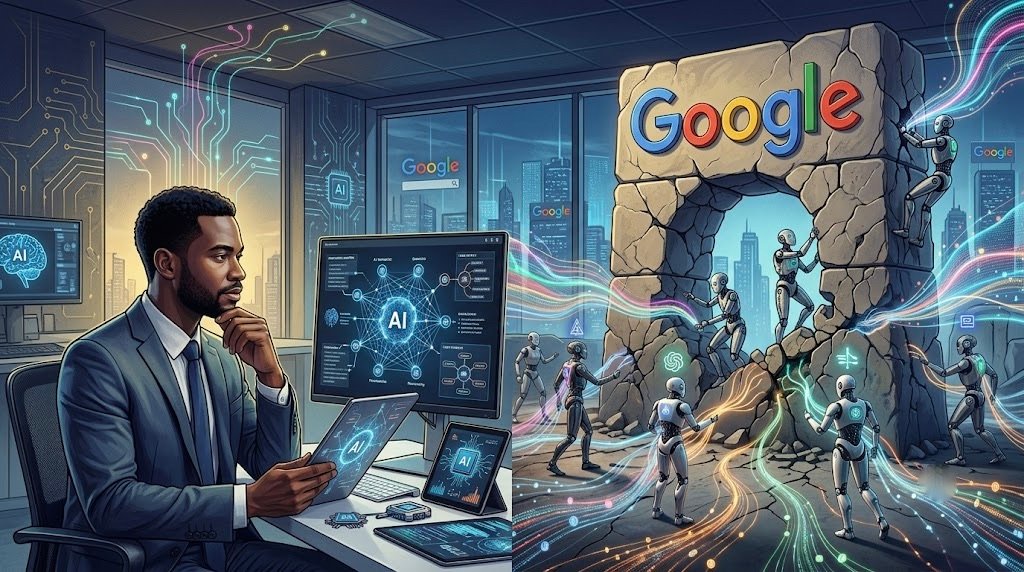
Google still looks untouchable on paper. Ninety per cent market share. Billions of queries every day. A brand so embedded in daily behaviour that people routinely search for Google on Google before typing their actual query. By every conventional metric, the dominance appears absolute.
And yet, quietly and without fanfare, something is shifting. More people are opening a chatbot before they open a search bar. Questions that would previously have generated a list of blue links are now producing a single synthesised answer. A generation of users has grown up treating social platforms and AI assistants as their default discovery tools, with traditional search engines occupying a secondary role if they appear in the research process at all.
Headline market share figures do not capture this shift cleanly. They measure search queries, not attention. They count the searches that happen, not the questions that get answered without a search engine ever being opened. By the time the numbers visibly move, the behavioural change has often been underway for years.
Marketers, business owners, and content creators who wait for the data to confirm the shift before responding will find themselves adapting to a new landscape while their competitors have already built positions within it. Understanding what is actually happening, who the challengers are, how user behaviour is changing, and what pratical steps can protect and extend brand visibility is the work that matters now.
The Giant Still Stands: What the Numbers Really Say About Google’s Dominance
Search market share figures require careful reading because they are measuring a moving and partially obscured target. When sources report that Google still holds 90 per cent of traffic, that figure represents a specific and bounded definition of search: queries entered into a search engine through a browser or the Google app. It does not capture questions answered within social platforms, enquiries resolved through AI assistants, searches conducted through voice interfaces that never register as browser queries, or the growing volume of discovery that happens within apps, maps, and ecosystem tools that never pass through a traditional search results page.
Within those boundaries, Google’s dominance is genuine and substantial. Default placement in Chrome, Safari, Android, and the majority of the world’s most-used devices and browsers keeps query volume high regardless of whether individual users would actively choose Google if the default were different. The deeply habituated behaviour that produces the phenomenon of searching for Google on Google, an act that makes no logical sense but reflects how thoroughly the brand has become synonymous with the act of searching, illustrates how much of Google’s traffic is structural rather than chosen.
| Search Tool | Global Desktop Share | Mobile Share | Year-on-Year Movement |
| ~91% | ~95% | Marginal decline | |
| Bing | ~4% | ~1% | Slight increase |
| Yahoo | ~1.5% | ~1% | Stable to declining |
| DuckDuckGo | ~0.6% | ~0.4% | Gradual growth |
| AI answer engines | Not yet captured in standard share data | Growing rapidly | Significant upward trajectory |
The more meaningful shift is happening in the gap between share of searches and share of attention. Google’s introduction of AI Overviews, which generate synthesised answers at the top of results pages, has reduced the proportion of users who click through to any website at all. Zero-click searches, where the answer appears directly in the results page without requiring a visit to the source, have been increasing for years and are accelerating as AI summaries become more comprehensive. A search engine can simultaneously hold ninety per cent of queries and deliver a declining proportion of referral traffic to the web it is indexing.
The early cracks in the structure are visible to analysts who look past the aggregate market share figure. Query volume growth has slowed. Competitor usage, particularly among younger demographics and in specific query categories, is rising steadily. Revenue pressure from AI answer engines that intercept commercial intent before it reaches a paid search result is a concern that Google’s own investor communications have begun to acknowledge.
How AI Tools Are Rewriting What Searching Means
Understanding AI that searches the internet requires distinguishing between several overlapping but distinct categories of tool.
Older generation chatbots worked from training data with a fixed cutoff date: they could answer questions but could not retrieve current information or cite live sources. The tools that are now reshaping search behaviour work differently. They retrieve live information from the web, synthesise it into a coherent answer, cite the sources they have drawn from, and blend retrieval with generated explanation in a way that produces a response more like a knowledgeable adviser than a list of links to follow independently.
The main formats currently competing for search attention include standalone AI answer engines that replace the search results page entirely, chat assistants with browsing capability that can be directed to research a specific question and report back, and traditional search engines, including Google and Bing, that have embedded AI summary layers into their existing results pages. Each represents a different point on the spectrum between classic search and conversational AI, and each is attracting a different segment of users.
| Factor | AI Search | Traditional Search |
| Answer format | Single synthesised response | List of ranked links |
| Source visibility | Cited but not always prominent | Direct link to source |
| Speed of answer | Immediate, no clicking required | Requires visiting multiple pages |
| Accuracy | Variable, can hallucinate | Dependent on source quality |
| Local results | Weak | Strong |
| Shopping intent | Limited commercial integration | Well-developed shopping features |
| Complex multi-part questions | Handles well | Requires multiple separate queries |
| Current events | Good when retrieval is live | Strong for indexed, recent content |
The honest debate about whether AI is better than Google resolves differently depending on the query type. For complex research, comparisons, multi-step planning, code assistance, and explanatory questions, AI tools consistently produce faster, more directly useful responses than a list of links to sources the user must then read and synthesise independently. For local business queries, shopping decisions, navigational searches, and anything requiring trusted real-time data with clear source accountability, traditional search retains meaningful advantages.
Google is responding with its own AI features, but the introduction of those features creates an internal tension: AI overviews that answer questions fully enough to satisfy users reduce the commercial value of the click-through ecosystem that funds the business. The company is simultaneously the incumbent defending a model and the challenger cannibalising it.
Behind the Quiet Shift: How Search Habits, Generations and Intent Are Changing
The move from keywords to full questions is one of the most visible surface changes in how people now approach information retrieval. A query that would previously have been expressed as “best running shoes for flat feet” is now more likely to be phrased as “What are the best running shoes for someone with flat feet who runs on roads and wants something durable?” The conversational phrasing reflects both the influence of voice search and the expectation that the tool receiving the query can handle natural language as well as a human interlocutor.
Generational patterns in search behaviour are significant and diverging. Younger users show measurably higher rates of starting research on social platforms, particularly short-form video, or in AI assistants before consulting a traditional search engine. For product discovery, entertainment, and trend-driven queries, social platforms have become primary rather than supplementary. For practical information retrieval, AI assistants are increasingly the first stop. Traditional search engines appear later in the process, if at all, often used to navigate to a specific destination once it has been identified through another channel.
Intent-based behaviour reveals where the traffic is flowing. Navigational searches, where the user knows where they want to go, still go predominantly to Google. Local service searches, where proximity and reviews matter, remain strong on traditional search. Commercial intent queries involving comparison and purchase are showing more fragmentation, with AI tools attracting users in the research phase before they move to a platform for the transaction. Explanatory and educational queries are the category most visibly shifting toward AI tools, because the synthesised answer format serves information-seeking intent more efficiently than a list of articles to read.
Zero-click behaviour, where users are satisfied by the information surfaced in a results page or AI response without visiting any source, is now the dominant pattern for a substantial proportion of queries. For publishers and websites that depend on search referral traffic, this trend means that maintaining or growing impressions does not translate as reliably to visits and conversions as it once did. The metric that matters is not ranking position but whether the brand is cited, referenced, or recommended by the tools that are answering questions on its behalf.
How to Spot the Shift in Your Own Audience
Step one: Open Google Search Console and compare impressions, clicks, and click-through rate over the past twelve months. Look specifically for pages that have maintained or increased impressions while losing clicks. This pattern, high visibility with declining engagement, is the most direct signal that AI summaries or zero-click results are intercepting queries that would previously have produced a visit.
Step two: Check analytics for referral traffic from AI tools and answer engines. Segment new users by source and device. If your analytics are not currently set up to identify AI tool referrals, configuring this tracking now creates the baseline data you will need to measure change over the coming months.
Step three: Ask new customers and leads directly how they found the brand. Add “AI assistant” or “chatbot” as an explicit option on inquiry forms and include it in new customer conversations. Self-reported discovery data is imperfect but provides qualitative signal that analytics alone cannot supply.
Step four: Run your top ten customer questions through two or three AI tools and record what happens. Is your brand mentioned? Is it cited as a source? Are competitors being recommended instead? Which page types, if any, are the AI tools referencing? This exercise produces actionable intelligence about where your content is and is not performing in the emerging search landscape.
Future-Proofing Your Visibility: A Practical Playbook for Brands in the AI Search Era
The appropriate response to this shift is not panic, and it is not abandonment of what is working. It is diversification: protecting existing search rankings while building the signals and content structures that support visibility in AI-generated answers and across the broader range of channels through which customers now discover brands.
Content that performs well in both traditional search and AI answer engines shares several characteristics. It demonstrates clear expertise and original insight rather than summarising what already exists. It is structured to answer specific questions directly, with the answer near the top of the page rather than buried after a lengthy preamble. It uses FAQ sections, schema markup, and clear topical coverage that helps both search algorithms and AI retrieval systems understand what the content is about and whom it serves.
Authority signals matter more than ever because AI tools, like search algorithms, assess credibility before deciding what to cite. Brand mentions across reputable sources, quality backlinks, verified reviews, named author credentials, and consistent business information across directories and listings all contribute to the trust profile that determines whether a brand gets referenced or overlooked.
Optimising for conversational and long-tail queries positions content for the way questions are now being asked, not the way they were phrased five years ago. For businesses serving specific cities and regions, local intent optimisation remains one of the highest-return activities because local queries are an area where traditional search retains strong advantages and where AI tools remain relatively weak.
The metrics worth tracking in this environment extend beyond rankings and clicks. Brand search volume indicates whether awareness is growing independently of paid activity. Citations in AI-generated answers, tracked through the manual testing process described above, measure a form of visibility that does not yet appear in standard analytics. Conversion rates from different referral sources reveal which channels are delivering commercially valuable traffic, not just volume.
Common mistakes to avoid: abandoning SEO investment before the data justifies it, on the basis that AI will replace search. Publishing thin AI-generated content that adds no original insight and therefore provides no reason for either a human or an AI tool to cite it. Ignoring the channels where customers are actually spending their discovery time while defending traffic from a channel that is gradually delivering less of it.
Google’s position is not collapsing overnight. The brands that treat the current moment as a reason to diversify their visibility strategy, rather than either panicking or ignoring the shift, are the ones that will still be discoverable when the landscape looks different than it does today.
Want your brand to stay visible wherever your customers search next? Partner with Opus Momentum, a growth-focused digital marketing agency Bhopal businesses trust, and build a search strategy that performs across Google, AI tools, and beyond.
Sources:
- https://gs.statcounter.com/search-engine-market-share
- https://sparktoro.com/blog/zero-click-searches
- https://developers.google.com/search
- https://www.gartner.com/en/newsroom
- https://www.thinkwithgoogle.com
- https://www.reuters.com/technology
- https://moz.com/state-of-seo
- https://searchengineland.com
- https://www.hubspot.com/marketing-statistics
- https://www.mckinsey.com/capabilities/quantumblack/our-insights