
Not long ago, marketers had one job: rank on Google. Today, the same team is expected to juggle three acronyms at once, each with its own rules, its own metrics and its own idea of what “visibility” even means.
Search engine optimisation still exists, but it now shares the stage with answer engine optimisation and generative engine optimisation. All three aim to get a brand noticed, yet they operate on very different mechanics.
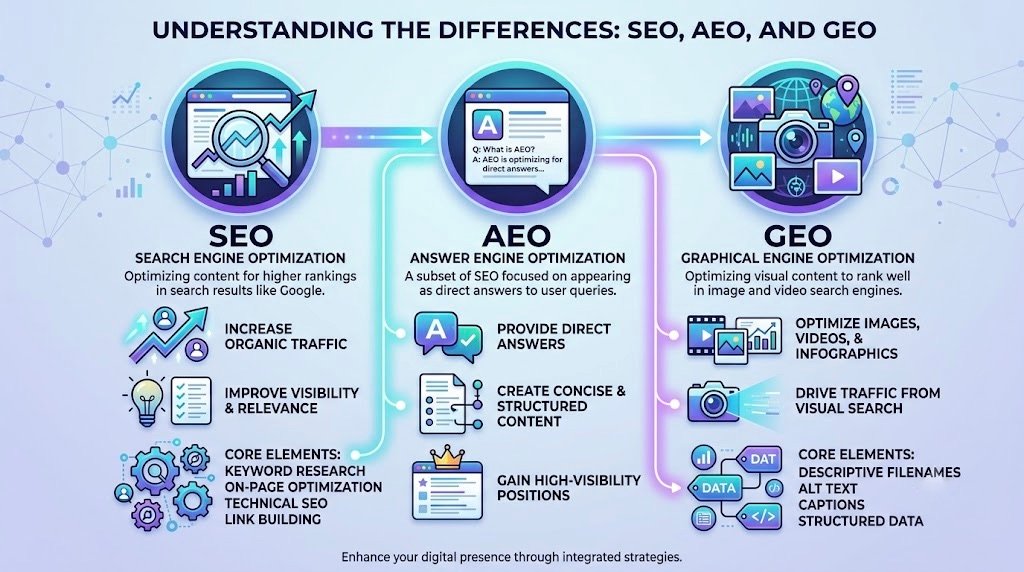
Understanding the core SEO vs AEO vs GEO differences is the first step before building any strategy. SEO ranks webpages in a results list. AEO focuses on being selected as the single best answer to a spoken or typed question. GEO is about being cited or summarised inside AI-generated responses from tools like ChatGPT or Perplexity. They overlap in places; technical quality and topical authority still matter everywhere, but treating them as one strategy is a mistake.
This shift matters at every scale. Businesses offering SEO services in Bhopal, much like agencies anywhere else, must now think beyond traditional rankings if they want to stay visible where their audience is actually searching.
The Foundation Everything Else Builds On
Classic search engine optimisation hasn’t disappeared; it has simply become the baseline rather than the finish line. Technical health, quality backlinks, on-page relevance and genuine user intent still determine whether a page can even be considered by any engine, human or artificial.
| Factor | Traditional SEO | AEO Equivalent | GEO Equivalent |
| Content structure | Keyword-optimised pages | FAQ and Q&A formatting | Clear, quotable statements |
| Authority signal | Backlinks | Featured snippet eligibility | Third-party citations and mentions |
| Technical layer | Site speed, crawlability | Schema markup | Structured, machine-readable data |
| Success metric | Ranking position | Voice/snippet capture | AI citation frequency |
Where SEO falls short is in a world increasingly shaped by zero-click searches and AI-generated summaries, where users get answers without ever visiting a website. A page can rank well and still receive no traffic if the answer is fully resolved on the results page itself.
Local SEO, however, hasn’t lost its relevance. For a digital marketing agency Bhopal clients search for it by name or by service; appearing accurately in local packs and map listings remains essential since regional intent still drives a large share of commercial searches.
Winning the Featured Snippet and Voice Search Battle (Answer Engine Optimisation)
AEO differs from traditional ranking in one key way: it isn’t about placing tenth or first; it’s about being chosen as the single answer read aloud by a voice assistant or displayed in a snippet box. Building an effective answer engine optimisation strategy comes down to a few practical moves:
- Structure content around clear, direct answers, using concise definitions, numbered steps and well-organised FAQs that give algorithms an easy match between a question and a response.
- Add schema markup, particularly FAQPage schema, since pages using it appear in AI Overviews roughly 3.2 times more often than pages without structured data.
- Use JSON-LD structured data to translate content into machine-readable entities and relationships, which improves how accurately large language models interpret a page.
- Write question-based headings that mirror how people actually speak rather than how they type, since AEO prioritises entity citation over pure ranking position.
- Prioritise clarity over keyword density, because voice search and smart assistant queries tend to be longer and more conversational than typed searches, and answer-first formatting performs better across both formats.
Getting Cited by AI Chatbots and Search Summaries (Generative Engine Optimisation)
It’s the practice of shaping content so that AI systems choose to pull from it, cite it or summarise it when generating a response to a user’s question. A landmark Princeton and IIT Delhi study formally defined the discipline and tested nine content strategies across 10,000 queries, finding that targeted optimisation can lift visibility in generative engine responses by up to 40 per cent. The mechanics behind AI-driven search optimisation rest on a few consistent, evidence-backed signals:
- Add specific statistics: including two to three well-formatted, contextually relevant numbers increased the citation rate by a relative 41 per cent in the study.
- Cite external sources: linking to credible, authoritative references acts as provenance for the model and was one of the top three performing strategies tested.
- Quote named experts: direct quotations attributed to real people boosted citation rates significantly, especially on opinion and debate-style queries.
- Improve fluency and readability: clean, well-structured prose consistently outperformed dense or jargon-heavy writing.
- Avoid keyword stuffing: it was the only tested tactic that measurably hurt AI visibility rather than helping it.
- Build broader authority beyond the page itself, since AI models also weigh how often and how consistently a brand is referenced across the web, which means public relations and digital PR now double as a search visibility tactic.
Building One Strategy for Three Channels
Mapping the future of search beyond Google requires treating SEO, AEO and GEO as layers of the same strategy rather than three separate workstreams competing for budget.
Maintaining search visibility in AI-era conditions doesn’t require duplicating effort. Most well-structured, authoritative content can satisfy all three channels simultaneously if it’s built with intent from the start.
| Requirement | SEO | AEO | GEO |
| Clear topical authority | Required | Required | Required |
| Structured data/schema | Optional | Required | Recommended |
| Direct, quotable answers | Optional | Required | Required |
| Original data or research | Recommended | Optional | Required |
| Consistent brand citations | Optional | Optional | Required |
Developing a cohesive content strategy for AEO and GEO alongside existing SEO efforts simply means auditing content once and asking three questions: does it rank? Does it answer? And would an AI system trust it enough to cite?
Where Opus Momentum Fits In
Opus Momentum is a digital marketing agency built around the idea that visibility should not depend on a single channel. Rather than treating search engine rankings, voice assistant answers and AI-generated citations as separate deliverables, the team designs content and technical foundations that work across all three from the outset. This integrated approach means clients don’t have to choose between chasing today’s algorithm and preparing for tomorrow’s, since the strategy is built to hold up across both.
Conclusion
The search landscape hasn’t fragmented so much as it has expanded. Opus Momentum approaches integrated search strategy by building content that performs across traditional rankings, voice assistants and AI-generated summaries at once, rather than treating each channel as an afterthought. Brands that adapt now will stay visible wherever their audience decides to search next.
Source
https://thegeocommunity.com/blogs/geo-princeton-paper-original-study
https://novarnish.com/insights/generative-engine-optimization-guide