
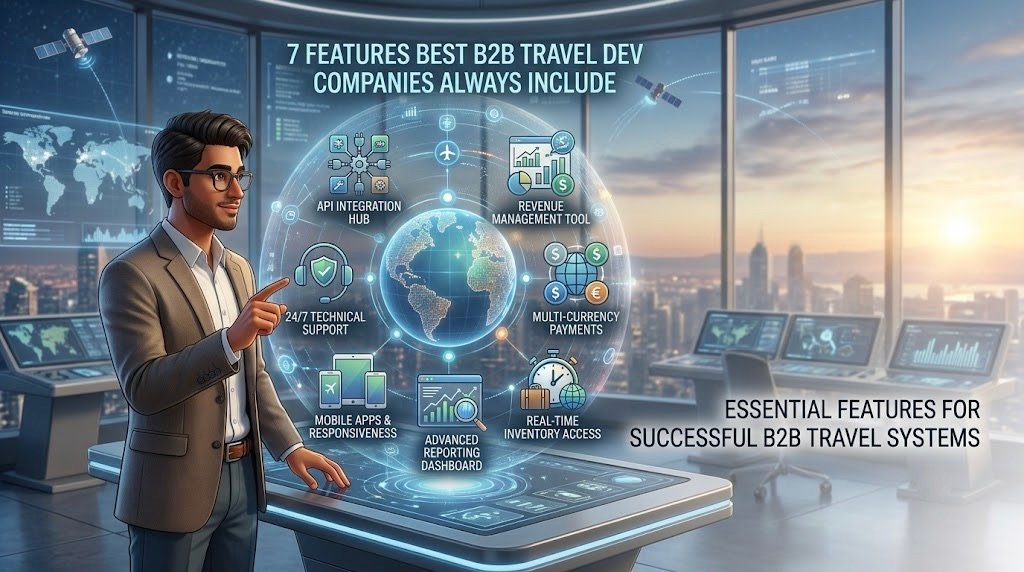
B2B travel platforms serve agents, corporate travel teams, wholesalers and sub-agents, not only individual holidaymakers. They must process complex prices, live supplier inventory, approval rules, commissions and servicing requests without slowing users down.
Agents and corporate buyers often judge a platform within minutes. If they cannot search, price, book and manage trips reliably, they will return to a familiar supplier. The strongest platforms combine seven capabilities: scalable integrations, dynamic packaging, live inventory, role controls, commercial automation, flexible pricing and corporate travel controls.
| B2B travel platform | B2C travel platform |
| Supports agents, branches, corporates and wholesalers | Serves individual travellers |
| Uses negotiated net rates, mark-ups and commissions | Displays consumer-facing prices |
| Requires permissions and role-based dashboards | Typically uses one customer account type |
| Handles credit limits, invoicing and reconciliation | Focuses on card payment and confirmation |
| Needs reporting for partner revenue and performance | Focuses on individual booking history |
Choosing A Travel Technology Development Company That Understands B2B
A specialist travel technology development company understands that a B2B portal is not simply a consumer booking site with a login area. It must manage multi-tier pricing, mark-ups, commission logic, credit terms and supplier connections accurately.
Ask prospective partners about their experience with GDS, NDC, API aggregators and third-party inventory feeds. IATA’s NDC standard supports airline offer and order processes, including shopping, ordering, payment, servicing, cancellations and refunds. Your platform should accommodate those workflows rather than treating booking as a one-time transaction.
| In-house build | Specialist development partner |
| Requires recruiting travel-tech, product and integration expertise | Brings established experience in booking flows and supplier connections |
| Gives direct internal control | Speeds delivery through proven architecture and processes |
| Can suit large teams with long-term capacity | Suits firms that need specialist execution and ongoing support |
| Carries hiring, maintenance and knowledge-retention risk | Requires clear scope, ownership and service-level agreements |
| May take longer to integrate multiple suppliers | Can design for integrations, monitoring and scale from the start |
Review relevant portal case studies, not only visual design work. Confirm how the partner will handle new markets, currencies, suppliers, user volumes and product types over time.
The Core Of B2B Travel Portal Development: Features Agents Actually Rely On
Effective B2B travel portal development gives partners the tools to create, book and service travel quickly.
1. Dynamic Packaging
Let agents combine flights, hotels, transfers, activities and add-ons into customised quotes. The platform should recalculate price, availability and rules when the itinerary changes.
2. Real-Time Inventory
Integrate supplier feeds so agents see current availability and rates. Support booking, change, cancellation, refund and order synchronisation workflows. Modern NDC APIs provide shopping, pricing, order creation, servicing and synchronisation functions.
3. Role-Based Access
Provide distinct permissions for super-admins, corporate travel managers, branch offices, agents and sub-agents. Each user should only view relevant inventory, pricing, reporting and customer data.
4. Automated Financial Controls
Automate invoices, credit limits, payment status, commission calculation and reconciliation. Clear financial workflows reduce manual intervention and help partners trust the platform.
What Makes A Good B2B Travel Booking System Stand Out From The Rest
A good B2B booking system remains fast and reliable during peak demand, fare changes and high-volume searches. It should return useful search results without exposing agents to stale rates or failed confirmations.
5. Flexible Pricing Rules
Configure mark-ups and discounts by agency, region, supplier, product, corporate contract or agent tier. Rules must be auditable so users understand the quoted price and finance teams can reconcile it.
6. International Support and Reporting
Support multiple currencies, languages, tax settings and regional payment methods for cross-border operations. Give each partner dashboards for bookings, cancellations, revenue, commissions, outstanding credit and top-selling routes.
A dashboard redesign should reduce clicks between search, quote, booking status and financial reporting. Test it with real agents before release, especially on frequent workflows rather than only the homepage.
Essential Features Of A Corporate Travel Portal Every Business Traveller Expects
Corporate travel needs guardrails, not unnecessary barriers. Travellers need a quick booking process, while managers need spend control, visibility and duty-of-care support.
7. Policy, Approval and Traveller Safety Controls
Build travel policy into search and booking flows. Highlight preferred suppliers, display out-of-policy choices clearly and route exceptional requests to the appropriate approver. Connect bookings to finance or expense systems so teams can track costs centrally.
Include itinerary visibility for authorised administrators and timely alerts that help them contact travellers during disruption. Strong access management is crucial because platforms handle personal, booking and financial data.
Best B2B Travel Platform Features That Tie Everything Together
The best B2B travel platform features work as one dependable system. Deep integrations are ineffective without accurate pricing rules. Live inventory creates risk without reliable booking and servicing states. Reporting becomes less useful if role controls and financial data lack consistency.
Prioritise depth over a long feature list. First ensure that the core search-to-service journey is accurate, secure, fast and observable. Then expand with new suppliers, markets, automation and partner-specific workflows.
Conclusion and Call to Action
The seven features that define a trusted B2B travel platform are dynamic packaging, real-time inventory, role-based access, automated financial controls, flexible pricing, international reporting and corporate policy and safety workflows.
Partner with Opus Momentum, a leading web development company in Bhopal, building B2B travel platforms that scale with your business. Get in touch for a free consultation.
Source: