
Stand outside the Bittan Market Reliance Trends on a Sunday evening and search “saree shop near me” on a phone. Then walk a kilometre to the Arera 10-Number main market and run the same search. The Map Pack will return a different three businesses. Walk another two kilometres into MP Nagar Zone-1 and the list shifts again. None of those nine businesses are necessarily the city’s best — they are the ones whose Google Business Profiles sit closest to the searcher with enough prominence to clear the proximity bar.
This is for owners and marketers of clinics, coaching institutes, salons, restaurants and service businesses across Bhopal who want to show up when somebody nearby reaches for their phone. Three takeaways: why “near me” in Bhopal is a multi-zone problem and not a single keyword, the five things that actually move the Map Pack here, and what to do this week if you currently rank nowhere.
What “near me” actually means in 2026
Google quietly stopped treating “near me” as a literal phrase years ago. Every local search now carries an implicit geo-signal — “best paediatrician” and “paediatrician near me” return roughly the same Map Pack from the same phone. The phrase is a behavioural marker now, not a query string. BrightLocal’s 2026 data has 46% of consumers saying they “always” or “often” tack “near me” onto local queries, and Google’s own research has long pegged 76% of mobile near-me searches as leading to a store visit within 24 hours.
What did change between November 2025 and January 2026 was the shape of the result page itself. AI Overviews now sit on roughly 15% of all Google searches globally, up from about 6% in early 2024, and local-pack ad density on tracked mobile keywords jumped from under 3% to 22% in that two-month window. The local pack itself is shrinking from three businesses to two, sometimes one, with an AI summary above and ads below. Showing up means surviving a leaner card.
For a business in Bhopal that means two things. First, GBP completeness is no longer hygiene — it is the only signal feeding both the slimmer Map Pack and the AI Overview that increasingly sits above it. Second, the proximity bar has tightened in dense urban zones because there are fewer slots to compete for.
Bhopal’s proximity geography is unusually messy
Bhopal is not one commercial centre. It has at least six that matter for local search — MP Nagar (offices, coaching, services), New Market (retail, eateries), Arera Colony’s 10 Number Market (mid-affluent retail and clinics), Bittan Market (evening retail and food), Kolar Road (residential-driven services), and the BHEL township belt. Vijay Nagar in Indore is a single dense corridor. Bhopal’s commercial activity is splattered across pockets separated by lakes, government land and arterial roads.
That fragmentation does two things to “near me” searches.
The proximity radius shrinks inside dense pockets. A search for “dentist near me” from inside MP Nagar Zone-1 will rarely surface a clinic in Arera E-3 even though it is a five-minute drive away — Google has enough density inside MP Nagar to fill the pack locally. Whitespark’s 2026 Local Search Ranking Factors survey still lists proximity as the third-strongest local pack factor, and in dense Indian Tier-2 commercial pockets the “near” in near-me has narrowed to under a kilometre.
The Bhoj Metro changes this. The first phase opened on 21 December 2025 between AIIMS Bhopal and Subhash Nagar. New high-traffic catchment areas around stations like Habibganj, MP Nagar and Alkapuri are now generating fresh “near me” search density, and businesses inside a 500-metre walk of those stations are getting a quiet visibility lift. Most local SEO audits in Bhopal still ignore this.
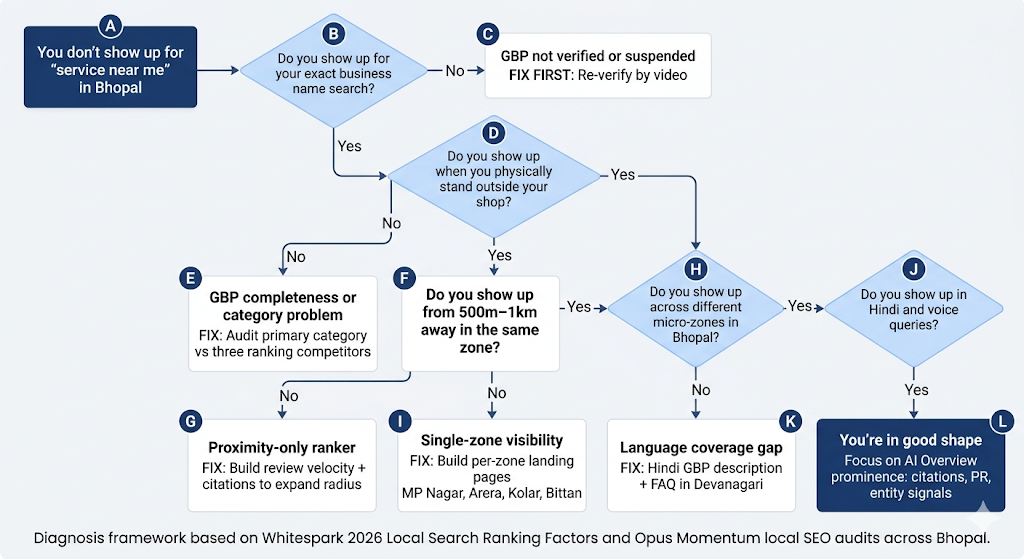
The five things that actually move “near me” rankings here
Most agency checklists list 25 ranking factors. Five of them do 80% of the work in Bhopal. Spend on these first.
1. GBP completeness, especially the categories
Eight of the top ten local pack ranking factors come straight from the Google Business Profile in Whitespark’s 2026 dataset. Inside the profile, the single most miscategorised field is the primary category. A coaching institute that selects “Educational Institution” instead of “Coaching Center” loses against any competitor who picked the more specific tag. A diagnostic lab that picks “Medical Center” instead of “Diagnostic Centre” forfeits half its near-me visibility. Pick the most specific primary category Google offers, then add up to two close secondary categories. Don’t keyword-stuff the business name — Google’s 2026 spam crackdown has been suspending listings with stuffed names since January, no warning.
2. Review velocity, not just review count
Volume matters less than rate. A clinic with 80 reviews accrued evenly over twelve months reads stronger to Google than a clinic with 200 reviews piled into one quarter. Rate is harder to fake, which is precisely why Google now weights it higher. Aim for two to four genuine reviews a week with reply text in either Hindi or Hinglish where the customer wrote in those languages — same-language replies signal local authenticity to Google’s NLP layer. Most Bhopal businesses reply only in English regardless of the review language. That is a free win sitting on the table.
3. The Hindi and voice search blind spot
Hindi voice queries on Google grew roughly 400% year-on-year per Google India’s 2025 reporting. About 65% of Indian users now use voice search, and 79% of Indian internet users say they trust a brand more when the message lands in their local language. In Bhopal, voice searches like “mere paas wala best dentist” or “sabse achha coaching centre near me” now show up in any local business’s Search Console queries if you bother to check. Most don’t.
The fix is mechanical. Add a Hindi services description in your GBP. Write at least one Q&A in your “Questions and Answers” section in Devanagari. Make sure your website has a translated services page or a Hindi FAQ block — this is the single most underused signal for AI Overviews surfacing your business in Hindi voice queries. Our SEO services work in Bhopal almost always starts here because it compounds fastest.
4. One landing page per micro-zone
If you serve customers across MP Nagar, Arera Colony and Kolar, build a real landing page for each. Not a doorway page with the city name swapped. A page that names the locality, lists landmarks (10 Number Market, Aura Mall, the BHEL gate), references actual nearby pin codes and includes embedded directions from Google Maps. Even a 600-word page beats nothing. Most Bhopal websites I look at have one “Service Areas” page listing six neighbourhoods in a single comma-separated line. That is invisible to Google.
If your site is on WordPress and the templates are messy enough that this work feels impossible, the website design and development we do for MP businesses usually starts with restructuring around exactly these zone pages.
5. Prominence — the only lever you actually own
Proximity is structural. You can’t move your shop. Prominence is buildable. Citations on Justdial, IndiaMART, Sulekha and Bing Places. Mentions in the Hindustan Times Bhopal edition or local lifestyle blogs. Backlinks from local college sites, business associations, and event coverage. AI Overviews, which now consume an increasing share of “near me” intent, are explicitly weighted toward entity prominence — how many places on the open web confirm that you exist, where you are, and what you do.
This is slow work. It is also the only work that compounds. We document what compounding looks like across MP businesses on our results page — none of those wins came from a single tactic.
What to do this week
If you currently don’t show up for any “near me” search in your category, in this order:
Audit your GBP primary category against three direct competitors who do show up. Match specificity. Pick up the phone and ask your last four genuinely happy customers for a Google review — by name, with a direct link, on WhatsApp, today. Translate your top-three service descriptions into Hindi and paste them into your GBP and your website’s services section. Identify your three most important micro-zones in Bhopal and stub out a landing page for each — not perfect, just real. Claim Bing Places if you haven’t, because it is the index ChatGPT and Perplexity read.
That’s a week of focused work, not a quarter. The compounding starts inside a month if the work is honest.
What to remember
- “Near me” in Bhopal isn’t one search — it’s at least six different geo-pockets, each with its own competitive ladder.
- Google’s 2026 result page is leaner. The Map Pack is shrinking, AI Overviews are growing, and only complete GBPs survive both.
- Hindi-language signals, micro-zone landing pages and review velocity are the three biggest underused levers for MP businesses.
If you want a more methodical second opinion on where your business actually sits in Bhopal’s local search ladder before you spend on tactics, our process walks through how we usually approach an MP local SEO audit. The first conversation is free and you’ll leave it with a punch list either way.
Frequently asked questions
Why does my Bhopal business show up for “near me” searches sometimes but not always?
Local pack results are a function of three things: where the searcher physically is, how relevant Google considers your business to the query, and how prominent your business looks across the open web. The first one moves constantly — a customer searching from inside Arera 10-Number gets a different pack than the same customer searching from MP Nagar. If you’re showing up sometimes but not always, you’re typically clearing the relevance and prominence bars but losing the proximity contest in certain zones. The fix is usually micro-zone landing pages plus more reviews, not a wholesale GBP rewrite.
Does claiming more local directories actually help “near me” rankings in 2026?
Yes, but with discipline. Citation consistency — your business name, address and phone matching exactly across Justdial, IndiaMART, Sulekha, Bing Places, Apple Business Connect and a dozen other Indian directories — is still a measurable prominence signal. Google reads these as third-party confirmations of your existence. Claim the four or five that matter, keep the data identical to your GBP, and stop. Listing on 200 generic directories does nothing useful and can pollute your citation footprint with bad data.
Should I worry about voice search if my customers are mostly English-speaking?
Probably less, but don’t ignore it entirely. Even English-speaking Bhopal users use voice search casually — “open clinics near me right now” is a voice-shaped query whether typed or spoken. The structural fixes for voice are the same as for AI Overviews: clear FAQ pages, conversational service descriptions, and structured data on operating hours and locations. If your website reads like a brochure, voice search will skip you regardless of whether the speaker is in Hindi or English.
How long before I see results from this work?
For GBP fixes, two to six weeks. Category corrections move rankings inside a fortnight. Review velocity changes show up in the local pack inside a month. Landing page work takes longer — eight to twelve weeks for Google to crawl, index and start ranking new zone pages. AI Overview visibility is the slowest signal — three to six months of consistent prominence work before LLM-driven results consistently surface your brand.
Is there a point where ranking in “near me” stops mattering because of AI search?
Not yet, and probably not for another two to three years in India. AI Overviews are eating clicks at the top of the page, but the underlying signals that surface a business in those summaries are roughly the same signals that rank in the Map Pack — GBP completeness, citations, reviews, and on-site clarity. Doing the local SEO work today builds the same prominence base AI search rewards. The two are converging, not diverging.