
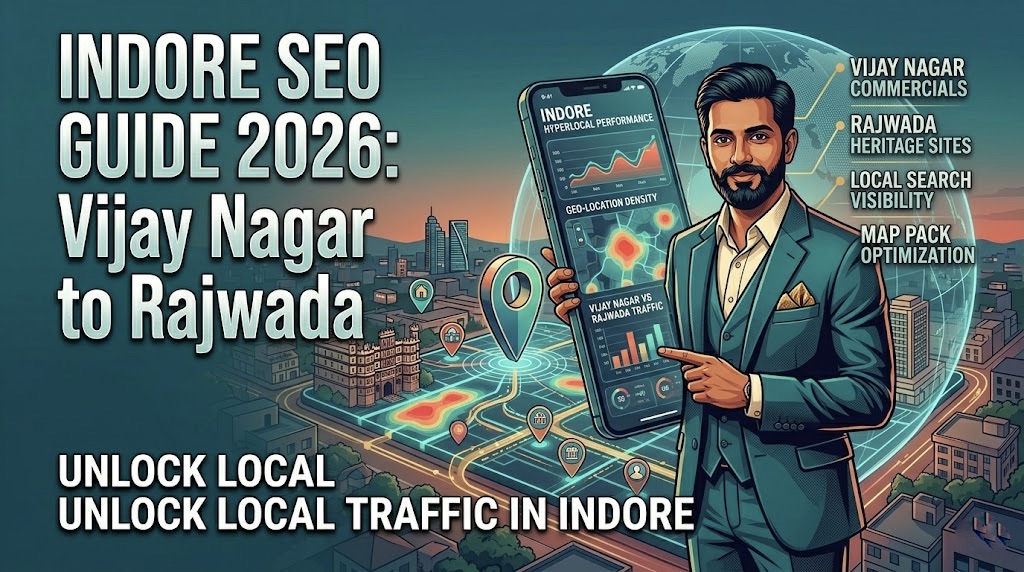
A “hospital near me” search inside the Rajwada gali solves a very different problem than the same search typed from a flat in Vijay Nagar. The first person is anxious, on foot, will pick the nearest open clinic with a half-decent photo. The second is on a desktop at 4pm, comparing three options, reading reviews, won’t book outside a 10-minute drive. Same query, same city, different worlds.
Most “Indore SEO” agencies write one landing page targeting seo services indore, slap on a list of 30 neighbourhoods in the footer, and call it hyperlocal. It isn’t. It’s stuffing. This article is for owners and marketers who actually want to rank in specific Indore localities and aren’t willing to ship spam pages to do it. By the end you’ll know which neighbourhoods earn a dedicated page, what those pages need to actually rank, and the three Google changes in the last six months that quietly rewrote the rules.
What hyperlocal SEO actually is in Indore (and what it isn’t)
Hyperlocal SEO ranks you for queries that combine a service with a sub-city geography. A neighbourhood. A market. A road. A landmark. Dentist in Vijay Nagar. Best chaat near Rajwada. 2 BHK on Super Corridor. The geography is finer than the city. The intent is sharper.
It is not “list every locality in your footer” SEO. That trick stopped working around 2019. Whitespark’s 2026 Local Search Ranking Factors report flags dedicated pages with thin or duplicate location content as one of the fastest ways to get filtered out of the local pack, and out of the AI Overview citations that increasingly sit above it. Those pages don’t help. They actively hurt.
It is also not “we put your address on the homepage.” That gets you onto the city radius. It does nothing for the customer typing salon Bhanwarkuan, seeing three competitors with neighbourhood pages, never scrolling down to your generic site.
The thing that makes hyperlocal hard in Indore is that Indore isn’t one city. It’s at least eight cities stacked next to each other.
The eight Indores you’re actually competing in
Indore is a metro area of about 3.48 million people in 2025. The commercial capital of Madhya Pradesh. Eighth-time Swachh Survekshan winner. The only Tier-2 Indian city with a TCS and an Infosys campus on its IT corridor. That last fact is what’s redrawing the locality map every quarter.
Here’s how the city actually segments by search intent.
Vijay Nagar. The corporate-residential heart. Flat prices sit at ₹4,600–₹6,500 per square foot in 2025, with land touching ₹12,950. Accenture, LTIMindtree, and Nagarro all have offices here. Winning searches are premium: psychologist in Vijay Nagar, coworking space Vijay Nagar, paediatrician Vijay Nagar. Buyers compare. Reviews matter more than proximity.
Rajwada. The historic market base. Search volume skews to retail, food, and traditional commerce: saree shop near Rajwada, gold chain Rajwada, best poha near Rajwada. The audience is older, Hindi-dominant, more likely to pick the first map-pack result with a photo of a real shopfront. They aren’t reading reviews. They’re driving past.
Sarafa Bazaar. A jewellery market by day (11am to 8pm) that flips into one of the country’s most documented street-food courts after 9pm. Sarafa is dense: hundreds of jewellers in a few hundred metres. Hyperlocal SEO here isn’t optional, it’s existential. If a Sarafa jeweller doesn’t rank for gold price Sarafa or bridal jewellery Sarafa, they’re invisible to the wedding-season searcher, even when they’re three shops down.
Palasia. The mid-premium retail and café belt. Old Palasia skews to legacy restaurants and clinics. New Palasia leans to cafés, salons, and gyms. Commercial lease rates run roughly ₹75–₹135 per square foot, which tells you a lot about who shops here.
Bhanwarkuan. Sits on AB Road (NH-52). Student-heavy, dense PG and rental market, coaching adjacent. Search behaviour is dominated by cheap, near hostel, open now modifiers. Food delivery Bhanwarkuan alone is a category nobody has properly cracked locally.
Super Corridor. The 8-km IT belt connecting the airport to Vijay Nagar. The newest neighbourhood on this list with the strangest search profile. Half the queries are still residential. The other half are B2B services for the IT campuses: cab service Super Corridor, office cleaning Super Corridor. Ranks are still soft. Whoever shows up consistently in the next 18 months will own these.
Pithampur. Twenty-five kilometres out. Pharmaceuticals, automotive, and FMCG manufacturing. Not B2C hyperlocal. B2B hyperlocal. Industrial machinery Pithampur. Pharma packaging Pithampur. Three or four queries a day, tiny volume, but each click can be worth lakhs in lifetime value.
Tukoganj, Saket, Manorama Ganj. The older middle-class residential belts. Quietly the highest-converting neighbourhoods for legacy services like CA firms, family doctors, and tuition centres. The audience is loyal. Search is more transactional than discovery-led.
You cannot run the same SEO strategy across all eight. The intent is different, the language is different, and the willingness to drive even three extra kilometres is different.
Which neighbourhoods deserve their own landing page?
This is the question every Indore business eventually asks. The wrong answer to it is “all of them, because more pages means more traffic.” That logic worked in 2017. In 2026 it gets you filtered.
Three filters before you build a neighbourhood page.

Filter one: do you actually serve customers from this neighbourhood? A pizza place in Bhanwarkuan does not serve Pithampur. A B2B agency in Vijay Nagar does serve Super Corridor. If you’ve never invoiced anyone from a locality and have no plan to, building a page is dishonest. Google’s helpful-content updates have gotten very good at sniffing that out.
Filter two: is there real search volume for “[your service] [this neighbourhood]”? Run it in Google Keyword Planner, free Ubersuggest, or Google Trends regional view. Some Indore neighbourhoods (Vijay Nagar, Palasia, Rajwada, Sarafa) have meaningful service-keyword volume. Others (Khajrana, MR-9, Bicholi Mardana) often don’t. That doesn’t make them bad neighbourhoods. It means their residents search by city or by landmark, not by neighbourhood name.
Filter three: can you write 600+ unique words about this neighbourhood that aren’t on your other pages? Real landmarks. Actual roads you drive to reach it. A price you’ve quoted there. A photo of your team on a job in that area. If the page would be a search-and-replace job from your Vijay Nagar page, don’t build it. Two strong neighbourhood pages outrank fifteen thin ones every time.
For most Indore SMEs, the right answer is three to five neighbourhood pages, not thirty. Cover where you actually do business, where the searches are, and write each page like a person, not a template. Our structured SEO approach for MP businesses is built around this: fewer, better pages, a properly stitched Google Business Profile, and a city-level pillar.
What a hyperlocal page actually needs
The most useful neighbourhood pages I’ve reviewed share four traits. None of them are the H1 stuffing trick most agencies still recommend.
A real reason the page exists, in the first 80 words. Not “we serve Vijay Nagar.” Something like: “We’ve delivered SEO for fourteen Vijay Nagar businesses since 2023. Coaching institutes around Bombay Hospital, three clinics off Scheme 54, two cafés near C21 Mall. Here’s what we’ve learned about ranking in this neighbourhood specifically.” The opening tells Google and the reader exactly why this page deserves to exist.
Genuine local proof. Two case studies, three photos with embedded EXIF location, a Google Maps embed of your actual location, the streets you regularly visit. Local prominence is one of Google’s three primary local ranking signals (alongside relevance and distance). Prominence is built from tiny verifiable details, not from “we are the best in Vijay Nagar.”
Pricing or quote ranges that match the neighbourhood. Rates in MP Nagar Bhopal aren’t rates in Vijay Nagar Indore. If your page says “starting from ₹15,000” on every locality, it reads like a template. If it says “for the average Vijay Nagar IT-services client, our retainer sits between ₹35,000 and ₹65,000 a month, scaling with the corridor’s CPC of ₹15–₹40 in tech keywords,” it reads like a real page from a real agency that’s worked this corridor.
A schema package that does its job. LocalBusiness schema with the precise lat/long. A serviceArea tied to a polygon, not a radius (Indore is non-circular). FAQPage schema for the three questions every neighbourhood page should answer: do you actually work here, what’s your rate range, how soon can you start. Google’s 2026 changes filter pages without rich grounding content out of AI Overview citations. Schema is increasingly the difference between being cited and ignored.
If you can’t honestly produce all four, the page isn’t ready. Skip it. Use those words to make your city pillar stronger.
Hindi vs English, and why it changes per neighbourhood
The voice search and Hindi keyword pattern shifts dramatically across Indore. Sona ka rate Sarafa outperforms gold rate Sarafa Bazaar on volume most weeks. Sasta PG Bhanwarkuan outranks cheap PG Bhanwarkuan. But in Vijay Nagar, the corporate audience switches to English by default. Psychologist near me Vijay Nagar dominates. The Hindi equivalent barely registers.
The pattern, after two years of watching this across MP: the more middle-class and corporate the neighbourhood, the more English-led the search. The more traditional and intergenerational the commerce, the more Hindi or Hinglish leads. Aata chakki near Tukoganj is real. Aata chakki near Super Corridor almost isn’t.
Don’t transliterate. If your audience searches in Hindi, the body copy should mirror that. Not in Devanagari only, but in Hinglish where search behaviour leads. A coaching institute targeting Bhanwarkuan ranks better with a paragraph using both NEET coaching and NEET ki taiyari naturally than with two pristine English pages. Most agencies don’t bother. They write one English template, run it through a translator for a hindi version, and wonder why neither ranks. The translator output is mechanical. Nobody talks like that.
Google Business Profile: the 20-area rule
A small but loud rule change matters here. As of the 2026 GBP guidelines, a service-area business can list up to twenty service areas. Not fifty. Not “all of Indore.” Twenty. For a multi-locality business, that means the service-area list inside your GBP becomes a strategic choice, not a kitchen-sink dump.
Three things to do with this.
First, pick the twenty that match where you actually serve. If you’ve never done a job in Mhow, don’t list Mhow. Inflated service areas dilute your relevance score for the localities that matter.
Second, group by drive time, not by alphabet. A salon in Palasia covering Palasia, New Palasia, Tukoganj, Saket, Manorama Ganj, and South Tukoganj is internally coherent (under fifteen minutes door to door). A salon claiming Palasia and Pithampur is sending mixed signals.
Third, link policy. Multi-location businesses now must point GBP profile links to location-specific pages, not the corporate homepage. So your Palasia profile should link to /locations/palasia/ rather than the homepage. This wasn’t always enforced; in 2025–26 it is. Postcard verification has also been deprecated for most service-area businesses, so video verification is now the default. Plan for a single continuous take that shows signage, interior, and a live management action.
The Whitespark 2026 report still puts Google Business Profile signals at roughly 32% of local pack rankings. That’s the single biggest lever, and the one most Indore SMEs ignore for the first six months of their digital push. We see this pattern repeatedly in the results we’ve shared: the businesses that move first on a clean, locality-tagged GBP win the local pack before content has time to compound.
What changed in the last six months
If you’ve searched for a service in Indore in the last quarter, you’ll have noticed the SERP looks different. AI Overviews now sit above the traditional 10 organic results for a growing share of local-intent queries. The local pack often folds into the Overview as a compact row, with citations from profiles that have rich grounding content (structured FAQs, schema, photos, recent reviews) and exclusion of profiles that don’t.
The implications are concrete. First, GBP photos and review velocity now feed AI Overview citations directly. Profiles updated in the last 30 days are cited; profiles untouched for six months mostly aren’t. Second, FAQ schema isn’t a nice-to-have anymore. AI Overviews specifically pull FAQ-formatted content into the answer block, and pages without it lose ground. Third, sites with thin neighbourhood content are worse off in 2026 than in 2024, because the AI Overview can ignore the local pack entirely if it can answer from rich content sources directly.
This is the moment when GEO services and traditional SEO start to overlap heavily for local businesses. The same things that get you cited in AI Overviews (structured content, schema, real reviews, recent updates) are the same things that protect your local pack visibility. There’s no longer a clean line between the two channels.
A realistic example: Sarafa Bazaar done right
Take a hypothetical Sarafa jewellery brand. The wrong move is a generic site with the homepage saying “Best jewellery in Indore.” The right move, in order:
A clean Google Business Profile with the exact Sarafa Bazaar address, twenty hand-picked service areas covering the wedding-season catchment (Vijay Nagar, Palasia, Saket, Manorama Ganj, MG Road, Tukoganj, Geeta Bhawan, Bengali Square, and a dozen others within a 9-km drive), and weekly photo posts of new pieces. That’s the foundation.
A homepage and a Sarafa-specific landing page. The Sarafa page covers gold price queries (sona ka rate Sarafa, gold price Sarafa Bazaar today), bridal collection categories, and the only thing that works in Sarafa SEO copy that doesn’t work elsewhere: heritage. Sarafa has been around about 100 years. That detail belongs on the page.
FAQ schema covering the three questions every Sarafa walk-in asks: kya tum hallmark certified karte ho (do you do hallmark certification), what’s the buyback policy, and what’s the difference between BIS and 22-karat in your stock. These aren’t padding. They’re the actual things people Google in the auto on the way over.
A monthly cadence of Google reviews. Not bought, not faked, just earned through SMS follow-ups within 48 hours of a sale. Reviews are the #1 local ranking factor in 2026, and Sarafa stores have an unusual advantage here: people who buy gold remember it. Asking is enough.
If a Sarafa jeweller does these four things consistently for six months, they will outrank 70% of their neighbours who are still relying on word-of-mouth and a flickering hoarding.
The mistakes I keep seeing in MP
Three patterns repeat across almost every Indore SME we audit.
First, locality pages built from search-and-replace. The Vijay Nagar page, the Palasia page, and the Rajwada page are 90% identical, with only the locality name swapped. Google’s content classifiers reliably identify these as duplicate intent, and you don’t get the rankings you’d hope for. A better architecture: one strong city pillar, plus three neighbourhood pages with genuinely different content based on what the audience in each neighbourhood actually searches for.
Second, GBP listed at the wrong granularity. A clinic chain with five branches across Indore lists one profile at the head office. Each branch needs its own profile, individually verified, with its own service area and review stream. Multi-location management now lives in business.google.com with Location Groups; the legacy per-profile interface was sunset in 2025.
Third, ignoring Hindi searches in neighbourhoods that demand them. We’ve audited maybe twenty Indore SMEs in the last year. Of those twenty, exactly three had any Hindi keyword research underpinning their content. The other seventeen were leaving 30 to 60% of their addressable search volume on the table, most of it concentrated in Bhanwarkuan, Rajwada, and the older residential belts.
If you want to see what a thoughtfully sequenced approach looks like end-to-end, our process page covers how we usually break this work down for MP businesses.
What to remember
- Hyperlocal SEO in Indore is about choosing three to five neighbourhoods to win, not stuffing thirty into a footer.
- A landing page earns its place only if you serve the neighbourhood, the search volume exists, and you can write 600+ unique words about it.
- Google’s 2026 changes (the 20-service-area cap, AI Overview citations, FAQ schema in answer blocks, the GBP link policy) have moved the goalposts in the last six months. Old playbooks ship pages that don’t rank.
If your team is figuring out where to focus a hyperlocal push in Indore, start a conversation with us. We’ll usually map a sequence neighbourhood by neighbourhood over a six- to nine-month window. Most of it is unglamorous; almost all of it compounds.
Frequently Asked Questions
How many Indore neighbourhood pages should a business actually build?
Most Indore SMEs are best served by three to five dedicated neighbourhood pages, not more. The math is simple: each page needs roughly 600 to 900 words of unique, locality-specific content, plus its own schema and proof. Three strong pages will outrank fifteen thin ones every time. If you serve more than five neighbourhoods meaningfully, your priority is a strong city pillar with mentions of secondary areas, not separate pages for each.
Is hyperlocal SEO different from local SEO?
Yes. Local SEO targets the city, like seo agency indore. Hyperlocal SEO targets the neighbourhood, market, road, or landmark, like seo agency vijay nagar or café near rajwada. The optimisation moves are the same in spirit (Google Business Profile, reviews, schema, content) but the granularity is finer, and the content has to actually be locality-specific to rank. A city page tagged with neighbourhood names in the footer is not hyperlocal SEO. It’s stuffing.
Should my Google Business Profile list every Indore locality I might serve?
No. As of the 2026 GBP guidelines, you can list up to twenty service areas, and inflating the list dilutes your relevance score for the areas you actually care about. Pick the twenty localities you genuinely serve, group them by drive time rather than alphabet, and update them annually. If you’ve never had a customer from Mhow, don’t list Mhow.
Do AI Overviews change how Indore businesses should think about local SEO?
They already have. AI Overviews now sit above the local pack for many Indore service queries, and they cite businesses with rich Google Business Profile content (recent photos, FAQ-formatted content, structured schema) while ignoring thin profiles. In practice, that means review velocity and FAQ schema are now ranking-critical, not optional. If your GBP hasn’t been touched in three months, you’re invisible to the AI Overview answer block.
How long does hyperlocal SEO take to show results in Indore?
For a clean Google Business Profile with active review collection, results in the local pack typically begin in 8 to 12 weeks. Neighbourhood landing pages take longer, usually 4 to 7 months to rank meaningfully, depending on competition. Vijay Nagar and Palasia are the most competitive Indore localities for service keywords; Bhanwarkuan and the older residential belts are softer and rank faster. Pithampur B2B keywords are slow but high-value.
What’s a realistic monthly budget for hyperlocal SEO in Indore?
For a Tier-2 Indian SME, a focused hyperlocal SEO retainer in Indore typically sits between ₹25,000 and ₹65,000 per month, depending on how many neighbourhood pages and how much GBP work is in scope. Add roughly ₹10,000 to ₹25,000 a month if Google Ads are running alongside. Anything significantly under ₹20,000 a month tends to be content-only and skips the GBP and schema work that does most of the ranking lifting.
Can I do hyperlocal SEO myself without an agency?
For a single neighbourhood and a Google Business Profile, yes. Most owners can run their own GBP, ask for reviews, and write a single locality page. Where it gets hard is the schema, the AI Overview optimisation, and the technical decisions around service-area polygons and link policy. Most owners hit the ceiling around month three. If your business is in a competitive Indore locality (Vijay Nagar, Palasia, Sarafa) and you’re competing against agencies, the in-house route slows down quickly.